

Published July 30, 2026
Improving Correctness in Agentic AI with Execution Guardrails
Agentic-AI AI-Governance AI-Reliability
What happens when an agentic AI system skips a critical step in a complex workflow?
Agentic AI systems can independently select and execute actions across multiple services. But a likely next action is not always the correct next action. In workflows where authentication, validation, approval, and execution must occur in sequence, one skipped or premature step can create operational and security risk.
As organizations scale AI-driven automation, ensuring that actions happen in the right order becomes more important, particularly as these systems move into production.
When AI Gets the Sequence Wrong
Traditional systems enforce order through predefined logic. One step must be completed before the next begins. However, when orchestration is handled by an AI agent, that sequencing can break down.
In practice, this can look like submitting a form before validation, executing a transaction before required checks, skipping authentication, or repeating steps that should only happen once.
These failures can occur in systems that optimize for likely next actions rather than strict process enforcement; and without safeguards, downstream systems may receive requests that are incomplete or out of context.
Consider a simple workflow:
- Verify identity
- Validate account
- Approve transaction
- Execute transfer
If an AI agent attempts the final step before the earlier steps are completed, the action may still appear valid on its own. But it breaks the required process and introduces risk.
Why Model-Level Controls Are Not Enough
Common techniques like prompt engineering, function constraints, and retry logic help guide AI behavior, but they are not a substitute for execution-time validation.
If an AI agent makes the wrong decision, that action can still be carried out and reach backend systems. What’s missing is a reliable way to verify that each step in the workflow has been completed correctly before the next action is allowed to proceed.
Introducing Tool Sequence Guardrails
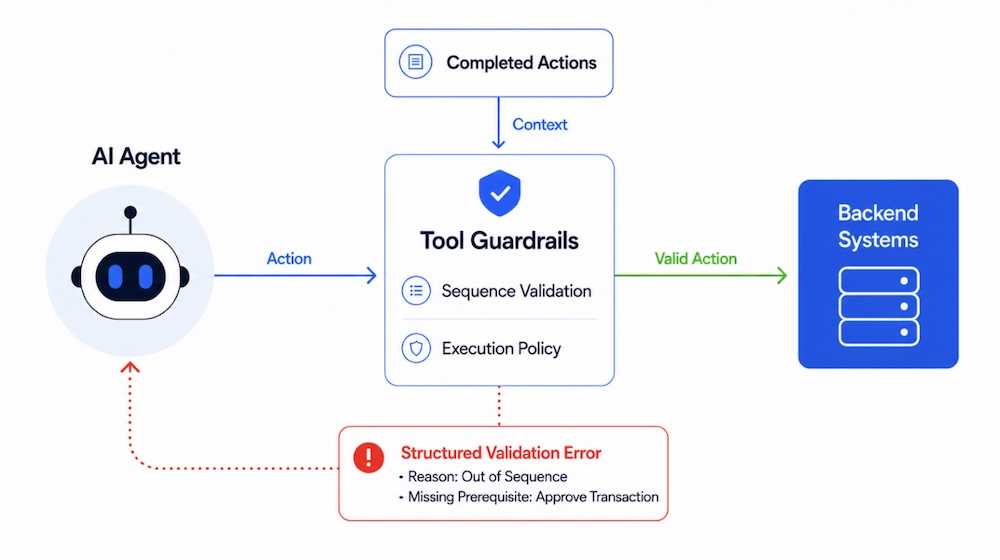
We use the term Tool Sequence Guardrails to describe an architectural control pattern that validates an agent’s requested tool calls against defined workflow rules before execution. Rather than relying on the agent to follow the workflow correctly, the control layer validates each requested action before it reaches backend systems.
Each request is evaluated against the requested action, the current workflow state, and the actions already completed. If the request aligns with the defined workflow, it proceeds. If not, it is blocked before execution.
How Guardrails Work
Before any action is executed, the system performs a set of validation checks:
- Prerequisite validation ensures required steps are completed
- Sequence enforcement confirms the action occurs at the correct point in the current workflow state
- Execution limits prevent excessive retries or unintended usage
If any of these checks fail, the request is stopped before it reaches downstream systems.
For example, if an agent requests Execute Transfer before Approve Transaction has completed, the guardrail is designed to reject the request and return a structured validation response identifying the missing prerequisite. The agent can then complete the required step, revise its plan, or escalate the workflow as appropriate.
In many implementations, these rules are defined through workflow configuration, allowing teams to specify prerequisites and limits without hardcoding logic. Depending on the architecture, the validation layer can be designed to minimize additional latency while helping prevent out-of-sequence actions.
Structured validation responses can provide consistent error codes or denial reasons, making it easier for both agents and downstream systems to understand why a request was rejected and determine the appropriate next step.
This approach shifts responsibility from the model to the system, helping ensure that requested actions are checked against workflow requirements before execution.
Why This Matters
Introducing control at execution time provides several benefits:
- Consistent workflow execution across different operating conditions
- Early prevention of out-of-sequence actions before they reach downstream systems
- Greater confidence when deploying AI-driven automation at scale
Tool Sequence Guardrails complement authentication, authorization, and policy controls by ensuring actions occur only after required workflow conditions have been satisfied.
It also improves visibility. Observability into allowed and blocked actions helps teams monitor behavior and refine rules over time.
Conclusion
Agentic AI introduces powerful capabilities, but it also introduces new challenges. In systems where order matters, correctness cannot rely on probability alone.
Tool Sequence Guardrails provide a way to enforce correctness at execution time, helping workflows remain reliable as AI systems scale. As these systems take on more responsibility in production environments, execution governance is an essential part of responsible agentic AI design.
About the Author

About the Author